Categories
Archbishop’s Teaching Uncategorized

5ème Dimanche après la Résurrection

Homélie de Son Excellence Mgr. Selim Sfeir Archevêque Maronite de Chypre (Jean 21 : 15 - 19)

Chers frères et sœurs en Christ,


Pierre s'est précipité la nuit de l'arrestation de Jésus, par amour excessif pour lui, il a déclaré qu'il ne l'abandonnerait pas et ne douterait pas de lui, oubliant qu'il était un homme faible, peut-être incapable de tenir ses promesses. La réponse de Jésus fut donc: "Le coq ne chantera pas que tu ne m`aies renié trois fois" Jean 13: 38

Ici, après la résurrection, dans une situation individuelle avec lui, Jésus se tient face à Pierre, qui l'a renié trois fois, non pas pour le faire honte de ses actes, non pas pour le blâmer pour son reniement, ni pour se venger de lui, mais pour lui exprimer son pardon. Les moments d'intimité avec Dieu sont les plus beaux, lorsqu'il pose son doigt sur la blessure qui nous fait souffrir, non pas comme Thomas l'a fait pour croire après le doute, mais pour guérir cette blessure qui saigne dans nos vies, parce que Jésus, qui connaît la profondeur de nos cœurs, ne doute pas de nous, mais croit en nous malgré notre fragilité!

Jésus a demandé à Pierre: "Simon, fils de Jonas, m'aimes-tu?" Pierre a répondu: "Oui, Seigneur, tu sais que je t'aime", puis Jésus lui a posé la même question une deuxième fois, et la réponse de Pierre était similaire à la première. Mais la troisième fois était la plus importante, " Pierre fut attristé de ce qu’il lui avait dit pour la troisième fois: M’aimes-tu? Et il lui répondit: Seigneur, tu sais toutes choses, tu sais que je t’aime." La tristesse de Pierre a fait émerger de sa profondeur une réponse qui porte en elle la repentance et la prise de conscience de la faiblesse de sa nature humaine. "Tu sais toutes choses." Oui, tu sais que je t'aime bien que j'aie failli et t'aie renié, alors je laisse maintenant à ton amour le soin de me juger! Dans ce contexte, l'apôtre Paul dit: " La tristesse selon Dieu produit une repentance à salut dont on ne se repent jamais." 2 Corinthiens 7:10

La question la plus importante que le texte nous pose: Comment le médecin des cœurs guérit-il la maladie du péché qui a fait tomber Adam, Pierre et nous? Le remède vient de la bouche de Jésus sous forme de question à Pierre, et à nous aussi: "M'aimes-tu?"

Oui, l'amour de Dieu est le remède. Qui peut maltraiter celui qu'il aime? Et s'il le fait, ne devrait-il pas être attristé comme Pierre, se hâter vers la repentance et demander pardon? La Bible nous dit: " La charité couvre une multitude de péchés." 1 Pierre 4: 8 Elle dit aussi: " l’amour couvre toutes les fautes." Proverbes 10:12 "Car l’amour est fort comme la mort." Cantique des Cantiques 8:6

" l’Éternel sonde tous les cœurs et pénètre tous les desseins et toutes les pensées." 1Chroniques 28: 9 Il connaît notre faiblesse et connaît combien nous l'avons renié dans notre comportement et nos actions. Mais il connait aussi que nous l’aimons, alors il pose la question à chacun de nous aujourd'hui, individuellement, comme il a interrogé Pierre: "M'aimes-tu?"

Dieu ne nous demande pas si on l’aime pour condamner pour nos péchés, mais il pose la question de son cœur qui a vécu l'amour jusqu'à se donner lui-même, pour éveiller les émotions de nos consciences, pour nous conduire à une repentance qui nous mène à notre salut. Dieu ne demande de nous que de l'amour, car tout ce que nous pouvons faire ou donner n'a de valeur qu'avec l'amour. " Quand un homme offrirait tous les biens de sa maison contre l’amour, Il ne s’attirerait que le mépris " Cantique des Cantiques 8: 7. Et l'apôtre Paul nous dit: "Quand je distribuerais tous mes biens pour la nourriture des pauvres, quand je livrerais même mon corps pour être brûlé, si je n’ai pas la charité, cela ne me sert de rien." 1 Corinthiens 13: 3

Nous nous repentons aujourd'hui devant Dieu et lui répondons: "Tu sais tout. Tu sais que je t'aime." Et avec le psalmiste, nous lui disons: " Sonde-moi, ô Dieu, et connais mon cœur! Éprouve-moi, et connais mes pensées! Regarde si je suis sur une mauvaise voie, Et conduis-moi sur la voie de l’éternité!" Psaumes 139: 23-24


† Selim Sfeir

Archevêque Maronite de Chypre


Categories
Archbishop’s Teaching Uncategorized

Dimanche de Thomas (Jean 20, 26-31)

2ème Dimanche après la Résurrection Homélie de Son Excellence Mgr. Selim Sfeir Archevêque Maronite de Chypre

Chers frères et sœurs en Christ,

Jésus est ressuscité des morts, oui, et il est apparu aux disciples réunis, mais pas à tous, car Thomas n'était pas avec eux. Lorsque les dix disciples ont informé Thomas de l'apparition de Jésus, il n'a pas cru, mais il a dit : " Si je ne vois dans ses mains la marque des clous, et si je ne mets mon doigt dans la marque des clous, et si je ne mets ma main dans son côté, je ne croirai point." (Jean 20:25).

Thomas est resté en lutte avec sa foi pendant une semaine entière, jusqu'à ce que vienne le nouveau dimanche. Ce qui nous confirme qu'il était en conflit interne avec sa foi, c'est qu'il était avec les disciples et ne les a pas abandonnés, et n'a pas abandonné l'Église réunie. Jésus leur est apparu à nouveau, et il s'est adressé directement à Thomas avec la réprimande de l'amour et non pas avec l'amour de la réprimande, et lui a dit : " Avance ici ton doigt, et regarde mes mains; avance aussi ta main, et mets-la dans mon côté; et ne sois pas incrédule, mais crois." (Jean 20:27)
Aucun des disciples n'avait informé Jésus de la position de Thomas ni de sa réponse, mais Jésus, présent dans la vie de Thomas, connaît ses détails les plus précis et veut le guérir de ses doutes.

Souvent, nous tombons dans de grands moments de doute, où nous perdons notre foi ; nous sentons que Dieu est loin de nous, et nos yeux ne le voient plus malgré sa présence et sa protection silencieuse sur nous. La volonté de Dieu n'est pas que nous restions dans le doute, ce n'est pas son désir que nous vivions dans l'incrédulité, mais il nous laisse une marge de retour à nous-mêmes, à la lutte interne constructive, et ensuite il se révèle à nous!

"Avance ici ton doigt, et regarde mes mains; avance aussi ta main, et mets-la dans mon côté." Par cette phrase, Jésus s'adresse à nous aujourd'hui comme s'il disait à chacun de nous : "Je connais tes doutes, je comprends tes inquiétudes, si tu veux croire en moi, ne t'éloigne pas, avance ton doigt et touche-moi, et ne tâtonne pas avec l’esprit du monde pour arriver à la foi. Ouvre tes yeux sur mes blessures, et ne focalise pas sur tes blessures, car dans mes blessures tu trouveras ta guérison!"

Le monde ne peut pas vous conduire à Jésus car il ne le connaît pas, "Il était dans le monde, et le monde a été fait par lui, et le monde ne l’a point connu" (Jean 1:10), car le monde ne peut pas comprendre Dieu par la logique humaine. Jésus dit : " celui qui est de la terre est de la terre, et il parle comme étant de la terre. " (Jean 3:31) Quant à l'apôtre Paul, il nous dit: " Car puisque le monde, avec sa sagesse, n’a point connu Dieu dans la sagesse de Dieu, il a plu à Dieu de sauver les croyants par la folie de la prédication." (1 Corinthiens 1:21)
Jésus s'adresse à Thomas avec une phrase dont les échos nous secouent encore, " Ne sois pas incrédule, mais crois." Tout comme il voulait que Thomas croie en lui, il veut que nous croyions en lui, mais le chemin de la foi qu'il trace exige de s'approcher de lui, de mettre nos mains dans les siennes, par l'expérience personnelle que l'esprit ne peut pas comprendre, et de regarder les blessures de ses mains et de voir les traces des clous.
Voir ces blessures conduit nos cœurs à croire en l'amour qui s'est donné lui-même sur la croix. Et toucher la trace des clous ouvre nos yeux pour voir ce que le monde ne peut pas voir. "Encore un peu de temps, et le monde ne me verra plus; mais vous, vous me verrez, car je vis, et vous vivrez aussi." (Jean 14:19) Ainsi seulement nous disons avec Thomas à Jésus : "Mon Seigneur et mon Dieu !"
Amen.

† Selim Sfeir
Archevêque Maronite de Chypre


Categories
Archbishop’s Teaching Uncategorized

Message de Pâques 2024 de Son Excellence Mgr Selim Jean Sfeir Archevêque Maronite de Chypre

Christ est ressuscité !

Chers frères et soeurs en Christ,

Christ est ressuscité !

Le Dieu de l'amour et de la vie a vaincu la mort et offre une vie nouvelle à quiconque
croit et identifie sa vie à Jésus-Christ ressuscité.
En ce jour saint de Pâques, alors que nous nous réunissons dans la joie et la gratitude,
réfléchissons tous à la signification profonde de la résurrection de notre Seigneur.
Pâques n'est pas seulement la célébration de la vie sur la mort, c'est aussi le
témoignage de la puissance de l'amour divin. C'est un rappel poignant que même
dans les moments les plus sombres de notre vie, il y a de l'espoir, il y a de la lumière,
il y a la possibilité d'une conversion et d'une transformation.

L'humanité connaît aujourd'hui de terribles tragédies qui découlent du mal humain.
Les guerres, les conflits, les conflits sanglants, la faim et la discorde frappent non
seulement notre région mais aussi la planète entière. L'égoïsme humain l'emporte
désormais sur l'unité, même au sein de la famille et de la société.

La résurrection du Christ nous enseigne que la réconciliation est possible, que la paix
est possible. En tant que disciples du Christ, baptisés au nom du Père, du Fils et du
Saint-Esprit, nous sommes appelés à être des ouvriers de paix, au service de l'unité
et de la compréhension mutuelle.

Jésus ressuscité est le seul à donner à l'homme l'espoir tangible que la bonté et
l'amour l'emportent toujours.

Mettons notre confiance en celui qui nous a ouvert le chemin de la vie, en celui qui
a donné sa vie pour nous afin de nous offrir la rédemption de nos péchés et de nos
faiblesses. En ce jour saint, engageons-nous à devenir meilleurs et devenir de
meilleurs chrétiens.

Que cette Pâque soit un temps de renouveau spirituel pour chacun d'entre nous.
Trouvons la force et le courage de pardonner, de guérir les blessures du passé et de
construire un avenir meilleur.

Souvenons-nous que la vraie victoire réside dans l'amour démesuré de Dieu.
Tournons-nous vers Celui qui nous a aimés jusqu'à se sacrifier et qui est ressuscité
pour nous donner une vie nouvelle. Abandonnons notre passé, ouvrons nos cœurs et
nos esprits, et empruntons le chemin de l'amour, de la bonté, de la réconciliation, de
la fraternité et de la solidarité.

Que la lumière et l'amour du Christ remplissent nos cœurs et guident nos actions afin
que les valeurs de paix, de justice et de réconciliation prévalent, non seulement à
Chypre et au Moyen-Orient, mais aussi dans le monde entier.

Que la paix et la grâce du Christ ressuscité soient avec vous tous, maintenant et à
jamais.

+ Selim Sfeir
Archevêque Maronite de Chypre

Categories
Archbishop’s Teaching Uncategorized

Messaggio di Pasqua 2024 da Sua Eccellenza Mons. Selim Sfeir Arcivescovo Maronita di Cipro

Cristo è risorto!

Cari fratelli e sorelle in Cristo,

Cristo è risorto!

Il Dio dell'amore e della vita ha vinto la morte e offre una nuova vita a chiunque
creda e identifichi la propria vita con Gesù Cristo risorto.
In questo santo giorno di Pasqua, mentre ci riuniamo nella gioia e nella gratitudine,
riflettiamo tutti sul significato profondo della risurrezione di nostro Signore.
La Pasqua non è semplicemente la celebrazione della vita sulla morte, ma è anche la
testimonianza del potere dell'amore divino. È uno struggente promemoria del fatto
che anche nei momenti più bui della nostra vita c'è speranza, c'è luce, c'è possibilità
di conversione e trasformazione.

L'umanità di oggi sta vivendo terribili tragedie che derivano dalla malvagità umana.
Guerre, conflitti, scontri sanguinosi, fame e discordia affliggono non solo la nostra
regione, ma anche l'intero pianeta. L'egoismo umano ha ormai la meglio sull'unità
anche all'interno della stessa famiglia e della società.

La risurrezione di Cristo ci insegna che la riconciliazione è possibile, che la pace è
possibile. Come discepoli di Cristo, battezzati nel nome del Padre, del Figlio e dello
Spirito Santo, siamo chiamati a essere operatori di pace, al servizio dell'unità e della
comprensione reciproca.

Gesù risorto è l'unico che dà all'uomo la speranza tangibile che il bene e l'amore
vincano sempre. Affidiamoci a Colui che ci ha aperto la via della vita, a Colui che
ha dato la vita per noi per offrirci la redenzione dal male e dal nostro io malvagio.
In questo giorno santo promettiamo a noi stessi che saremo cristiani migliori e
persone migliori.

Che questa Pasqua sia un momento di rinnovamento spirituale per ciascuno di noi.
Troviamo la forza e il coraggio di perdonare, di guarire le ferite del passato e di
costruire un futuro migliore.

Che la vera vittoria è nell'amore supremo di Dio. Avviciniamoci a
Colui che ci ha amato fino alla morte ed è risorto per darci una nuova vita.
Lasciamoci alle spalle la nostra vecchia vita, apriamo i nostri cuori e le nostre menti
e camminiamo sul sentiero dell'amore, della gentilezza, della riconciliazione, della
fratellanza e della solidarietà.

Che la luce e l'amore di Cristo riempiano i nostri cuori e guidino le nostre azioni per
lavorare per la prevalenza dei valori di pace, giustizia e riconciliazione non solo nella
nostra Cipro e nel Medio Oriente, ma anche nel mondo intero.

La pace e la grazia del Signore risorto siano con tutti voi, oggi e sempre.

+ Selim Sfeir
Arcivescovo Maronita di Cipro

Categories
Uncategorized

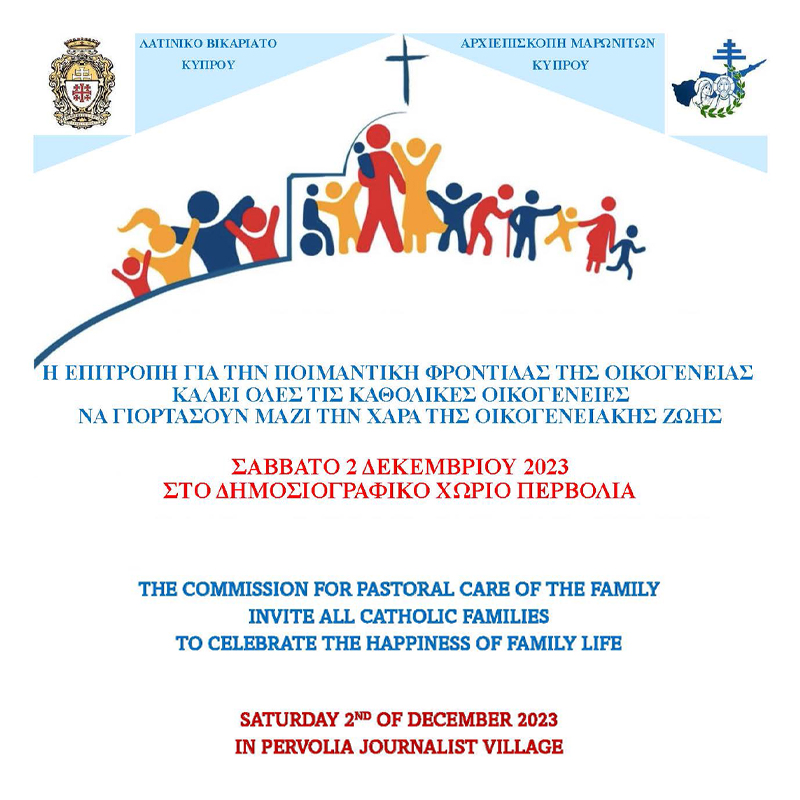
CELEBRATE THE HAPPINESS OF FAMILY LIFE

THE COMMISSION FOR PASTORAL CARE OF THE FAMILY
INVITE ALL CATHOLIC FAMILIES
TO CELEBRATE THE HAPPINESS OF FAMILY LIFE
SATURDAY 2ND OF DECEMBER 2023
IN PERVOLIA JOURNALIST VILLAGE


PROGRAMME:
9:30: Arrival and accommodation
10:00: Introduction and morning prayer
10:15: Presentation of the theme
11:00: Coffee break
11:30: Work in groups
12:00: Summary of the work in groups
13:00: Lunch
14:00: Sacrament of confession and
preparation of the Eucharist
15:00: Holy Eucharist
16:00: Recreation time .
17:00: Departure from Pervolia

LOCATION: ANALIA RESTAURANT-LARNACA
IN PERVOLIA JOURNALIST VILLAGE

NB. You may register your families with your parish priest until 20th November.
For lunch please prepare a food that we will all share together, all kind of goods are
welcome to celebrate together.

Categories
Uncategorized

Synod Report: A Church that involves everyone and is close to world’s wounds


Synod Report: A Church that involves everyone and is close to world’s wounds

https://www.vaticannews.va/en/vatican-city/news/2023-10/the-synod-report-a-church-that-involves-everyone.html


The Synthesis Report at the conclusion of the 16th General Assembly of the Synod on Synodality is published. Looking ahead to the second session in 2024, the text offers reflections and proposals on topics such as the role of women and the laity, the ministry of bishops, priesthood and the diaconate, the importance of the poor and migrants, digital mission, ecumenism, and abuse.

By Salvatore Cernuzio

Women and the laity, diaconate, ministry and magisterium, peace and the climate, the poor and migrants, ecumenism and identity, new languages and renewed structures, old and new missions (including the “digital” mission), listening to all and probing everything more deeply, even the most 'controversial' issues. In the Synthesis Report approved and published today by the 16th General Assembly of the Synod on Synodality, there is a renewed look at the world and the Church and their demands. After four weeks of work, which began on 4 October in the Paul VI Hall, the General Assembly concluded its first session today in the Vatican.

The document of some forty pages is the result of the work of the assembly that took place “while wars both old and new have raged in the world, with dramatic consequences that are impacting upon countless victims.” The report continues, “The cry of the poor resounded among us, of those forced to migrate and of those suffering violence and the devastating consequences of climate change. We heard their cry not only through the media, but also through the voices of many present, who were personally involved in these tragic events whether through their families or their people” (Foreword).

To this challenge and many others, the universal Church has tried to offer a response in the Small Circles and in the interventions. Everything came together in the Synthesis Report, which is divided into a preface and three parts, and which traces the path for the work to be done in the second session in 2024.

Listening to all, beginning with victims of abuse

As in the Letter to the People of God, the synod assembly reaffirms an “openness to listening and accompanying all, including those who have suffered abuse and hurt in the Church”, which “addressing the structural conditions that abetted such abuse, remains before us, and requires concrete gestures of penitence”.

The face of a synodal Church

Synodality is a first step. It is a term that the participants in the Synod themselves admit is “a term unfamiliar to many members of the People of God, causing some people confusion and concern” (1 f), including fears of a departure from tradition, a debasement of the hierarchical nature of the Church (1 g), a loss of power or, on the contrary, immobility and a lack of courage for change. “Synodal” and “synodality” are instead terms that “speak of a mode of being Church that integrates communion, mission, and participation”. So they indicate a way of living the Church, valuing differences and developing the active involvement of all. This begins with deacons, priests, and bishops: “A synodal Church cannot do without their voices” (1 n), we read. “We need an understanding of the reasons for resistance to synodality by some of them”.

Mission

The document continues explaining that synodality goes hand in hand with mission. Hence, it is necessary that “Christian communities are to enter into solidarity with those of other religions, convictions and cultures, thus avoiding, on the one hand, the risk of self-referentiality and self-preservation, and on the other hand the risk of loss of identity” (2 e). In this new “pastoral style”, it would seem important to many to make “liturgical language more accessible to the faithful and more embodied in the diversity of cultures” (3 l).

The poor at the centre

Ample space in the Report is devoted to the poor, who ask the Church for “love”, understood as “respect, acceptance, and recognition” (4 a). “For the Church, the option for the poor and those at the margins is a theological category before being a cultural, sociological, political or philosophical category” (4 b), the document reiterates, identifying the poor not only as those who are materially impoverished, but also migrants; indigenous peoples; victims of violence and abuse (especially women), or racism and trafficking; people with addictions; minorities; abandoned elderly people; and exploited workers (4 c). Among “the most vulnerable of the vulnerable, on whose behalf constant advocacy is needed, [are] the unborn and their mothers”, the document continues. “The Assembly hears the cry of the ‘new poor’, produced by wars and terrorism that plague many countries on several continents, and the assembly condemns the corrupt political and economic systems that cause such strife”.

The most vulnerable of the vulnerable, for whom constant advocacy is needed, are the children in the womb and their mothers," reads the text of the Assembly, which says it is "aware of the cry of the 'new poor' produced by wars and terrorism also caused by 'corrupt political and economic systems'.

Commitment of believers in the field of politics and for the common good

In this sense, the Church is urged to be committed both to the “public denunciation of the injustices” perpetrated by individuals, governments, and companies; and to active engagement in politics, associations, trade unions, popular movements (4f and 4g). At the same time, the consolidated action of the Church in the fields of education, health, and social assistance, “without any discrimination or the exclusion of anyone”, must not be neglected (4 k).

Migrants

There is also a focus on migrants and refugees, “many of whom bear the wounds of uprooting, war and violence”. They “often become a source of renewal and enrichment for the communities that welcome them and an opportunity to establish direct links with geographically distant churches” (5 d). Faced with increasingly hostile attitudes towards them, the General Assembly says, “We are called to practice an open welcome, to accompany them in the construction of a new life and to build a true intercultural communion among peoples”. Fundamental in this sense is “respect for the liturgical traditions and religious practices of migrants” as well as respect for their own language. For example, a word like “mission”, in contexts where “the proclamation of the Gospel was associated with colonization, even genocide”, is laden with “painful historical memories” and “hinders communion today” (5 e). “Evangelising in these contexts requires acknowledging mistakes made, learning a new sensitivity to these issues”, the document states.

Combating racism and xenophobia

Equal commitment and care is required of the Church “to engage decisively in education, in the culture of dialogue and encounter, combating racism and xenophobia, especially through pastoral formation” (5 p). It is also urgent to identify “systems within the Church that create or maintain racial injustice” (5 q).

Eastern Churches

Remaining on the subject of migration, the Report looks to Eastern Europe and the recent conflicts that have caused the flow of numerous faithful from the Catholic East into territories with a Latin majority. It is necessary, the Assembly says, “for the local Latin-rite Churches, in the name of synodality, to help the Eastern faithful who have emigrated to preserve their identity and cultivate their specific heritage, without undergoing processes of assimilation is the request of the Fathers” (6c).

On the road to Christian unity

With regard to ecumenism, the Report speaks of a “spiritual renewal” that requires “processes of repentance and healing of the memory” (7c). It goes on to quote Pope Francis’ expression about an “ecumenism of the blood”; that is “Christians of different affiliations who give their lives for faith in Jesus Christ” (7d), and it mentions the proposal for an ecumenical martyrology (7o). The Report also reiterates that “collaboration among all Christians” is a resource “for healing the culture of hatred, division and war that pits groups, peoples and nations against each other”. It does not forget the issue of so-called mixed marriages, which are realities in which “it is possible to evangelize each other” (7 f).

Laity and families (Part II)

“Laymen and laywomen, those in consecrated life, and ordained ministers have equal dignity” (8b): this conviction is forcefully reiterated in the Synthesis Report, which recalls how the lay faithful are “increasingly present and active in service within Christian communities” (8e). Educators in the faith, theologians, formators, spiritual animators, and catechists, active in safeguarding and administration: their contributions are “indispensable to the mission of the Church” (8 e). The different charisms must therefore be “called forth, recognized and fully appreciated” (8 f), and not be ignored, underutilized, or “clericalised” (8 f).

Women in the life and mission of the Church

There is, then, a call for a strong commitment on the part of the Church to accompany and understand women in all aspects of their lives, including pastoral and sacramental ones. Women, it says, “cry out for justice in societies still marked by sexual violence, economic inequality and the tendency to treat them as objects” (9 c), adding “Pastoral accompaniment and vigorous advocacy for women should go hand in hand”.

Clericalism

Many women present at the Synod “expressed deep gratitude for the work of priests and bishops”, but “also spoke of a Church that wounds" (9 f). “Clericalism, a chauvinist mentality, and inappropriate expressions of authority continue to scar the face of the Church and damage its communion”. A “profound spiritual conversion is needed as the foundation for any effective structural change”; and the General Assembly noted that “we desire to promote a Church in which men and women dialogue together… without subordination, exclusion, and competition” (9h).

Opening the diaconate to women?

Various opinions on opening the diaconate to women were acknowledged (9 j): for some, it is “unacceptable because they consider it a discontinuity with Tradition”; for others, it would restore a practice of the early Church; still others see it as “an appropriate and necessary response to the signs of the times … that would find an echo in the hearts of many who seek new energy and vitality in the Church”. Then there are those who are concerned that opening the diaconate to women would involve “a worrying anthropological confusion, which, if granted, would marry the Church to the spirit of the age”. Fathers and mothers of the Synod ask to continue “Theological and pastoral research on the access of women to the diaconate”, making use of the results of the commissions specially set up by the Pope, as well as the theological, historical and exegetical research already carried out: “If possible”, they say, “the results of this research should be presented at the next Session of the Assembly” (9 n).

Discrimination and abuse

In the meantime, the urgency of ensuring “that women can participate in decision-making processes and assume roles of responsibility in pastoral care and ministry” is reiterated, noting that canon law should be adapted accordingly (9m). Cases of employment discrimination and unfair remuneration must also be addressed, including those in the Church where consecrated women are often considered “cheap labour” (9 o). Similarly, women’s access to theological education and training programmes must be expanded (9 p), including promoting the use of inclusive language in liturgical texts and Church documents (9 q).

Consecrated Life

Looking at the richness and variety of the different forms of consecrated life, the Report warns against the “persistence of an authoritarian style, which makes no room for dialogue”. The Report notes, too, that “cases of abuse of various kinds experienced by those in religious life and members of lay associations, especially of women, signal a problem in the exercise of authority and demand decisive and appropriate interventions” (10 d).

Deacons and formation

The Assembly then expresses gratitude to ordained ministers, who are “called to live their service to the People of God in a disposition of proximity to people, welcoming and listening to all, while cultivating a deep personal spirituality and a life of prayer” (11b). The Report warns against clericalism, a “distortion of the priestly vocation” that “needs to be challenged from the earliest stages of formation” by ensuring “close contact” with the people and those in need (11 c). The request is also expressed, along these lines, that seminaries or other courses of formation of candidates for the ministry be linked to the daily life of communities (11 e), in order“to avoid the risks of formalism and ideology that lead to authoritarian attitudes, and impede genuine vocational growth”.

Celibacy

Mention was made of the theme of celibacy, which received different evaluations during the assembly.” Its value is appreciated by all as richly prophetic and a profound witness to Christ”; the Report says, while noting that some ask “whether its appropriateness, theologically, for priestly ministry should necessarily translate into a disciplinary obligation in the Latin Church, above all in ecclesial and cultural contexts that make it more difficult. This discussion is not new but requires further consideration”.

Bishops

There is ample reflection on the figure and role of the bishop, who is called to be “an example of synodality” (12 c) by exercising “co-responsibility”, understood as the involvement of other actors within the diocese and the clergy, so as to lighten the burden of “administrative and legal commitments” which can hinder his mission (12 e). Coupled with this, the bishop does not always find the human and spiritual support he needs, while “a certain sense of loneliness is not uncommon” (12 e).

Abuses

On the question of abuse, which “places many bishops in the difficult situation of having to reconcile the role of father with that of judge” (12 i), the Report supports the exploration of the “appropriateness of assigning the judicial task to another body, to be specified canonically” (12 i).

Formation (Part III)

A “synodal approach” is then requested for formation, with the recommendation that work be undertaken “on relationship and sexual education, to accompany young people as they mature in their personal and sexual identities and to support the maturation of those called to celibacy and consecrated chastity” (14 g). The Report emphasizes the importance of deepening “the dialogue between the human sciences” (14 h) so as to enable “careful consideration of matters that are controversial within the Church” (15 b) – that is, among other issues, matters “such as those relating to matters of identity and sexuality, the end of life, complicated marital situations, and ethical issues related to artificial intelligence”. Issues such as these are controversial precisely “because they pose new questions” in society and in the Church (15 g). “It is important to take the time required for this reflection and to invest our best energies in it, without giving in to simplistic judgments that hurt individuals and the Body of the Church”, the Report says, while recalling that “Church teaching already provides a sense of direction on many of these matters, but this teaching evidently still requires translation into pastoral practice”.

Listening

With the same concern, the Report renews the invitation to hear and accompany “people who feel marginalized or excluded from the Church because of their marriage status, identity or sexuality”. “There was a deep sense of love, mercy and compassion felt in the Assembly for those who are or feel hurt or neglected by the Church, who want a place to call ‘home’ where they can feel safe, be heard and respected, without fear of feeling judged”, the document says, while insisting that “Christians must always show respect for the dignity of every person” (16 h).

Polygamy

In light of the experiences reported in the Synod hall by some members of the Synod from Africa, SECAM (Symposium of Episcopal Conferences of Africa and Madagascar) is encouraged to promote “a theological and pastoral discernment” on the topic of polygamy and the accompaniment of people in polygamous unions who are coming to faith” (16 q)

Digital culture

Finally, the Synthesis Report speaks of the digital environment: “It is up to us to reach today's culture in all spaces where people seek meaning and love, including the spaces they enter through their cell phones and tablets” (17 c), bearing in mind that the internet “can also cause harm and injury, such as through intimidation, disinformation, sexual exploitation, and addiction”. The Report adds, “There is an urgent need to consider how the Christian community can support families in ensuring that the online space is not only safe but also spiritually life-giving” (17 f).

 

Categories
Uncategorized

Pope to Synod: the Holy Spirit is the protagonist

https://www.vaticannews.va/en/pope/news/2023-10/pope-synod-closing-after-voting-process-remarks1.html
Pope Francis reminds the Synodal Assembly that the Holy Spirit is the gathering's protagonist, and offers his heartfelt thanks to all, as he addressed the closing session of the XVI Ordinary General Assembly of the Synod on Synodality, which concludes with the Holy Mass on Sunday in the Vatican.

By Deborah Castellano Lubov

The Holy Spirit is the protagonist of this Synod...

The Pope offered this powerful reminder during the closing session of the XVI Ordinary General Assembly of the Synod of Bishops, which took place Saturday in the Vatican, in his brief remarks.

The Holy Father began his remarks, in Spanish, thanking all those who have played a key role in the synodal gathering.

“I want to remind you that the protagonist of this Synod is the Holy Spirit, and so I suggest you take away with you the text of St Basil that was prepared for us by Father Davide Piras: keep meditating on it, it can help us.”

Categories
Uncategorized

Synod Round Tables

SYNOD ROUND TABLES
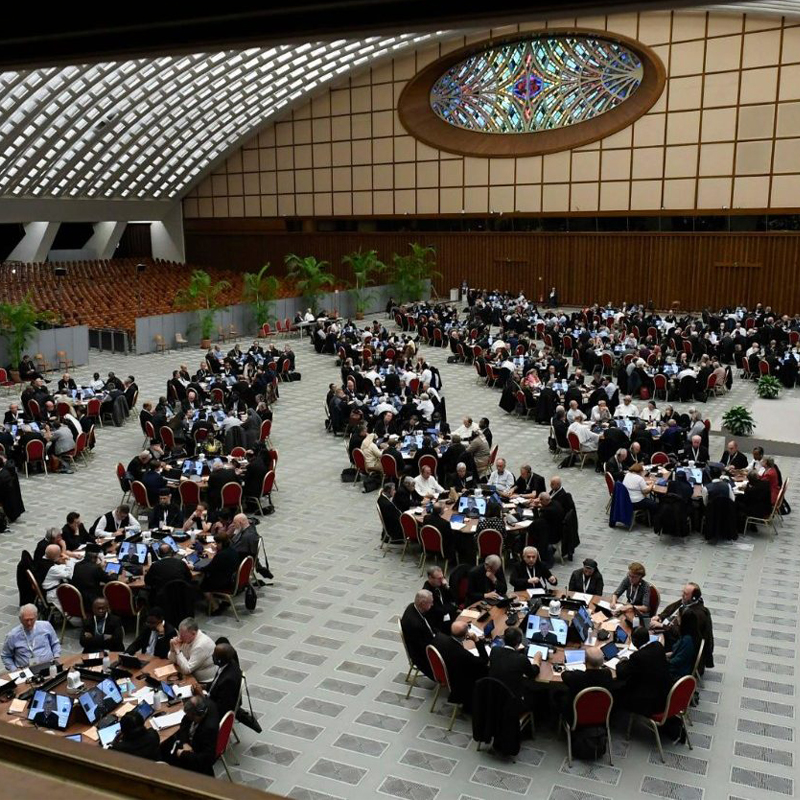
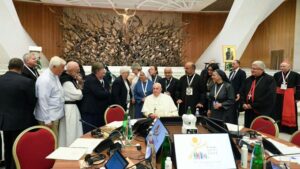
In this assembly, the synod hall has a different layout from what used to be in the other synods before. The amphitheater format used in other synod assemblies has been abandoned and the use of round tables has been adopted, where 12 people at each table sit side by side, face to face, eye to eye, comprising of bishops, priests, Religious men and women and lay men and women. They are brought together by the common languages in which they can communicate, so that they can dialogue and discern together. The panel of the Risen Christ by Nervi and the Salus Populi Romani icon have been used to decorate the ‘new’ Synod Hall, where the Working Groups and the General Congregations will take place.

Categories
Uncategorized

“The Holy Spirit guides us toward harmony and respectful listening” Said the Pope to the Synod

Pope Francis reminds the Synodal Assembly that the Holy Spirit is the Synod's protagonist, no one else, and calls for expressing one's self freely, while respectful listening to all, as he addressed the Opening of the XVI Ordinary General Assembly of the Synod on Synodality, which opened today in the Vatican.

"The protagonist of the Synod isn't us, but the Holy Spirit," says Pope Francis, insisting that if the Spirit is in charge, it is a good synod, and if He is not, "it is not."

The Pope gave this powerful reminder during the Opening of the XVI Ordinary General Assembly of the Synod of Bishops
He suggested that if we finish the Synod exactly in the same way, "without a nuance, then it's not a Synod.""Particularity," he said, "needs to be incorporated into the Church," underscoring, "this needs to be done by the Holy Spirit, not by us."

Pope Francis reminds the Synodal Assembly that the Holy Spirit is the Synod's protagonist, no one else, and calls for expressing one's self freely, while respectful listening to all, as he addressed the Opening of the XVI Ordinary General Assembly of the Synod on Synodality, which opened today in the Vatican.
"The protagonist of the Synod isn't us, but the Holy Spirit," says Pope Francis, insisting that if the Spirit is in charge, it is a good synod, and if He is not, "it is not."
The Pope gave this powerful reminder during the Opening of the XVI Ordinary General Assembly of the Synod of Bishops
He suggested that if we finish the Synod exactly in the same way, "without a nuance, then it's not a Synod.""Particularity," he said, "needs to be incorporated into the Church," underscoring, "this needs to be done by the Holy Spirit, not by us."
https://www.vaticannews.va/en/pope/news/2023-10/pope-to-synod-may-christ-lead-the-way.html
Categories
Uncategorized

Pope Francis At The Opening Mass Of The Synod

Pope at opening Mass for Synod: Let us walk with the Holy Spirit

Pope Francis presides at the Holy Mass in St Peter’s Square for the Opening of the XVI Ordinary General Assembly of the Synod of Bishops, and invites the faithful to walk with the Holy Spirit, “in trust and with joy”.

In his homily, Pope Francis recalled a “difficult moment” in Jesus’ earthly ministry, recounted in the day’s Gospel. “In the moment of desolation,” the Pope said, “Jesus has a gaze capable of seeing beyond: He praises the wisdom of the Father and is able to discern the good that grows unseen, the seed of the Word welcomed by the simple, the light of the Kingdom of God that shows the way even in the night.”

At the beginning of the General Assembly, the Pope said, “we do not need purely natural vision, made up of human strategies, political calculations, or ideological battles.” Instead, he said, “We are here to walk together with the gaze of Jesus, Who blesses the Father and welcomes those who are weary and oppressed.”

https://www.vaticannews.va/en/pope/news/2023-10/pope-at-opening-mass-for-synod-let-us-walk-with-the-holy-spirit.html

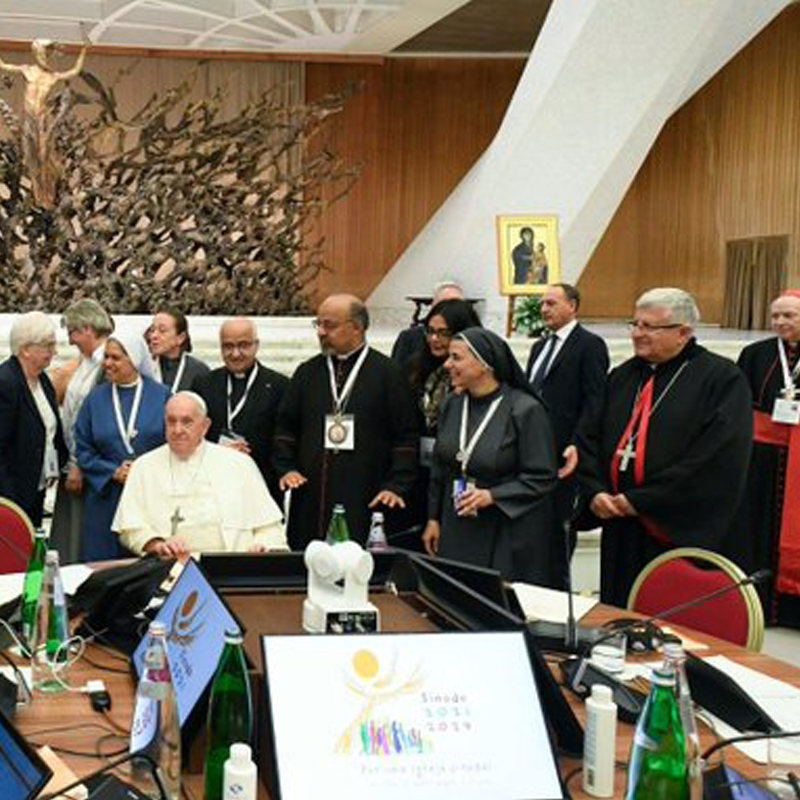
Let us pray for the Synod, and for our Archbishop H.E. Msgr. Selim Sfeir who is participating in this Synod.